
Sitting down to talk about It Takes Two in 2026, it feels like reminiscing about a classic that has fundamentally reshaped how we think about cooperative play. The game’s journey to the Nintendo Switch was a pivotal moment, bringing its unique brand of relational chaos to a portable platform. I recently had the chance to dive into the minds behind this adventure—Josef Fares of Hazelight Studios, and Scott Cromie and Louis Polak from Turn Me Up, the team responsible for the Switch adaptation. Their insights reveal not just the challenges of a port, but the very philosophy that makes this game so special.
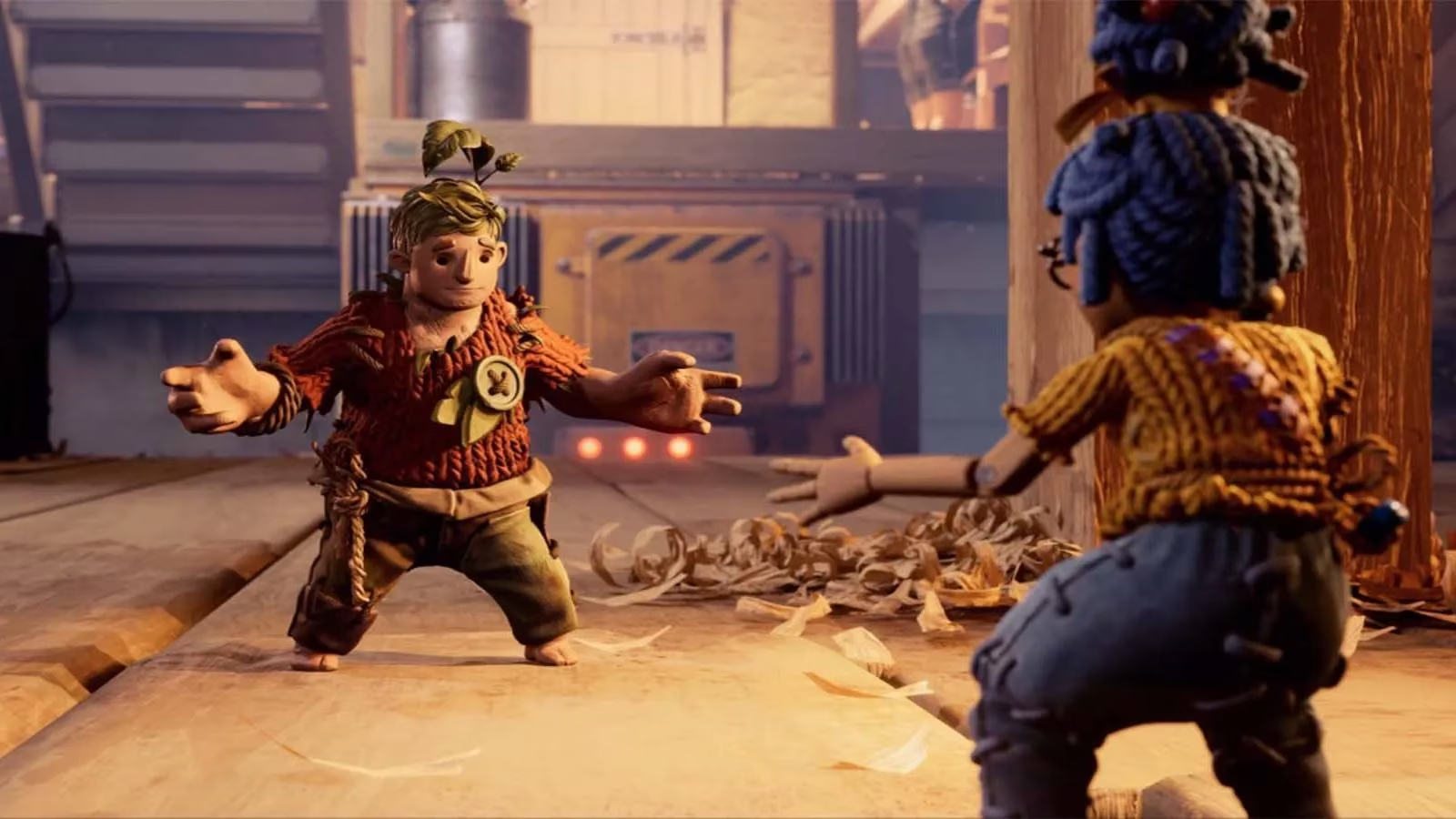
The conversation began, fittingly, with a question of identity. Who did they see themselves in more: the meticulous, cautious Cody, or the more impulsive, driven May? Josef Fares, the game’s writer and director, found it impossible to choose. "I connect with both of them," he admitted. "Being so close to the game, you become part of both." With a characteristic grin, he added, "But I will say, the character I connect with most is Dr. Hakim, because I do all the mo-cap for him. So all the dancing and swinging is actually me." Louis Polak, a producer at Turn Me Up, leaned toward Cody, citing a shared temperament, while Executive Producer Scott Cromie rounded out the trio by associating with May. It was a small but telling start—this game is built on duality and perspective.
Bringing this "Game of the Year" experience to the Switch was no small feat. Polak outlined the core challenges: sky-high player expectations, the sheer uniqueness of every level, the expansive environments, and the fundamental, unchangeable fact that this is a purely split-screen co-op game. "Those were some of the main challenges that we had to make sure we handled in the proper way," he said. The port wasn't just a simple translation; it was an adaptation. To make it truly sing on the go, they introduced local wireless play, allowing two Switch consoles to connect without Wi-Fi or a TV. They also added new voice-overs in Japanese, Spanish, French, and German, and performed unique UI-scaling to fit the handheld's screen. It was about preserving the magic, not just copying it.
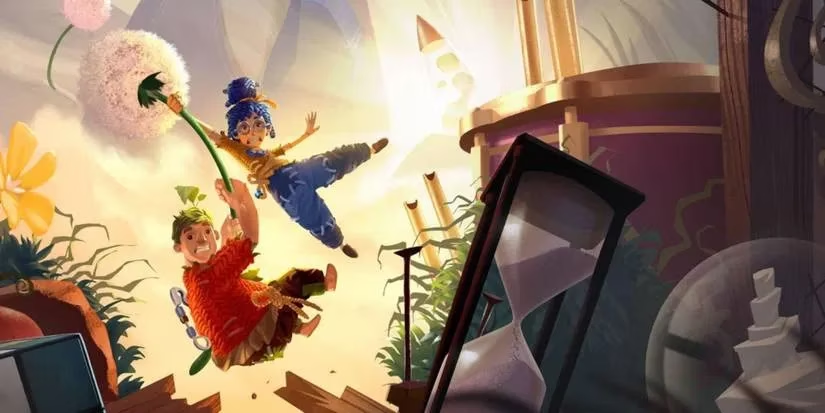
Our talk naturally drifted to the game's legacy. It Takes Two proved a moving, narrative-driven experience could be built exclusively for two. What's next? Could we have stories for three, four, or even more players? Fares was thoughtful. "I think, first of all, you can explore lots more in co-op-only games," he began. "We tell stories to each other. We go to the cinema together. So there’s definitely more to explore." However, he highlighted the immense complexity. "The problem is, the more players you go with, the harder it is to control the story. It’s almost like the players are creating their own story." He pointed out the existing challenge with two players: different tempers, different focus levels, the potential for one player to inhabit a character they don't relate to. "I definitely believe you can go further than we have," he concluded, "but it’s way more complex."
One of the game's most celebrated aspects is how it resonates with couples. Was that the design intent? "Not really with couples in mind, but with co-op in mind," Fares clarified. Hazelight's games are conceived, written, and designed from the ground up as co-op-only experiences. This isn't a single-player campaign with a tacked-on split-screen mode. "You cannot play it alone. You have to play together all the time." Yet, through internal testing, they stumbled upon an unexpected truth. Testers would react, "Oh s**t, these guys have something to work on." The game, with its themes of communication and collaboration, became a kind of relationship litmus test. "Once you are playing it with somebody very close to you, whoever it is, it kind of tests where your relationship is," Fares mused. "I think it's a really good first date thing as well." 😄
Of course, the future beckons. The announced Amazon film adaptation is still in the early script stages. "Hollywood can be a bit tricky sometimes," Fares noted with the experience of a former filmmaker. "But they seem pretty serious about the script. I hope something cool comes from it!" His primary focus, however, remains firmly on Hazelight's next project. The tease of what's to come is always exciting.
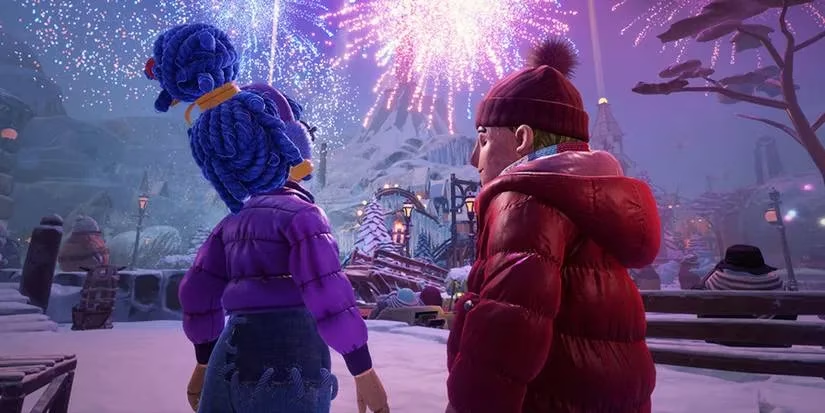
No conversation with Josef Fares is complete without discussing his famous, fiery creative philosophy. His advice to young creatives remains as potent as ever: "Fk st up!" He elaborated, "It sounds like I’m just being silly, but whenever somebody new starts at Hazelight, I tell them ‘It’s time lose all your brain cells.’" What he means is to break conventions and believe fiercely in your own ideas. "Don’t listen too much to others’ opinions... With that said! I don’t mean ‘f* the audience.’ No! Make sure the audience loves your game. Don’t try to make a game you think the audience will love. Really follow your passion." He believes we are still in the infancy of understanding game design. "Games have an extreme amount of stuff that needs to be explored. So I say go outside your comfort zone. Do something that surprises you. Shock yourself."
This philosophy even applied to cuts within It Takes Two itself. The original ending was scrapped because it switched mechanics too drastically and felt out of context. And the now-infamous elephant scene? "It was way more violent in the beginning, and we pushed it back a little bit... not because of how people reacted to it; it's just that it would steal too much attention. I love that scene. I think it's nice."
Finally, we touched on the eternal comparison: games vs. films. Fares, having worked in both, was characteristically blunt. "I will make movies in the future as well, but I often say, when I want to go on vacation, I’ll make a movie. It’s so much easier." He explained that filmmaking, while difficult, is a predictable process refined over a century. Game development, by contrast, is a frontier. "It’s almost like we are exploring everything again." The core difference is interactivity. "In a game, [players] are f***ing around with everything. It would be like having people present on set, moving the cameras, playing with the actors." This makes controlling pacing, emotion, and narrative infinitely harder. "I know that the movie industry is under-appreciating what games are about... And I think that games can have a stronger emotional touch than a passive medium."
As our talk wrapped up, Fares wanted to circle back to the Switch port, reminding everyone of the new language options. It was a fitting endnote—a detail that underscores the team's commitment to sharing their uniquely collaborative story with as many people as possible, in whatever way they choose to play. Looking back from 2026, It Takes Two stands not just as a fantastic game, but as a bold statement: that the most powerful stories are the ones we navigate together, one jump, one argument, and one heartfelt moment at a time.