
It’s 2026, and I’m still buzzing from the latest Game Awards ceremony. Geoff Keighley’s show has become as much a part of my holiday season as twinkling lights and overindulgent snacks. Looking back at the winners since 2014 is like unspooling a reel of film that captures not just the best games, but the very soul of our hobby in each passing year. The Game of the Year award isn’t just a trophy—it’s a time capsule, a mirror reflecting what we, as players, cherished most. So, let’s take a walk down memory lane, all the way from Dragon Age to the most recent victor.
2014: Dragon Age: Inquisition
BioWare’s fantasy epic kicked off the tradition. It was like a sprawling novel that wrapped you in its lore, even if the tactical combat felt a bit like herding cats in a thunderstorm. Inquisition’s victory set the tone: The Game Awards love ambition over polish, and that’s a rule that still holds.
2015: The Witcher 3: Wild Hunt
If Inquisition was a novel, The Witcher 3 was a library. A masterpiece that redefined open-world storytelling, it’s the game I keep returning to, like a favorite blanket that somehow gets softer each year. CD Projekt Red’s subsequent stumbles with Cyberpunk 2077 only make this win shine brighter—proof that lightning can indeed strike twice… after a lot of patches.
2016: Overwatch
Blizzard’s hero shooter burst onto the scene like a confetti cannon at a LAN party. It was a vibrant, joyous revolution that made me believe in teamwork again. Even now, with Overwatch 2 expanding the universe, that first year still feels like catching lightning in a bottle.
2017: The Legend of Zelda: Breath of the Wild
Here’s where the bar went vertical. Breath of the Wild wasn’t just a game; it was a philosophy. It taught a generation of developers that true freedom means letting players climb every mountain and cook every radish. I still measure every open-world game against it with the same hopeful skepticism I use when trying a new pizza place—if it’s not as good, I’m disappointed, but I’ll keep searching.
2018: God of War
2018 was a bloodbath of a year. God of War emerged victorious from a nominee list that read like a hall of fame. Playing as Kratos, a gruff dad shouldering an axe and centuries of regret, felt like watching a glacier learn to cry. It was narrative alchemy, and I’ll forever be grateful to Santa Monica Studio for showing that even gods can grow up.
2019: Sekiro: Shadows Die Twice
FromSoftware’s ninja ballet was the underdog that triumphed over giants. Sekiro is a razor-sharp haiku of a game: precise, punishing, and profoundly beautiful. It wasn’t just a Soulslike; it was a lesson in patience, like learning to dance with death one deflect at a time. And it left us all hungry for Elden Ring—but that’s a story for a later year.
2020: The Last of Us Part II
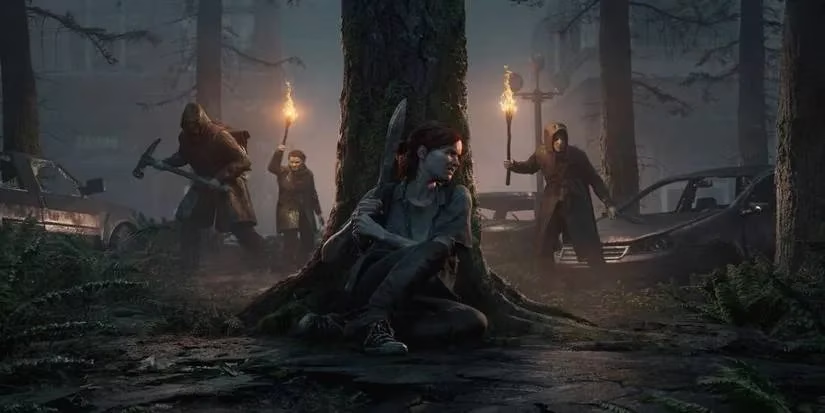
A technical marvel that cleaved the fanbase in two like a well-placed machete swing. Love it or hate it, The Last of Us Part II was a watershed moment for storytelling in games—brutal, exhausting, and unflinchingly human. It won a record 300 Game of the Year awards, and in 2020, that felt like a statement about how far we’ve come in treating games as art.
2021: It Takes Two
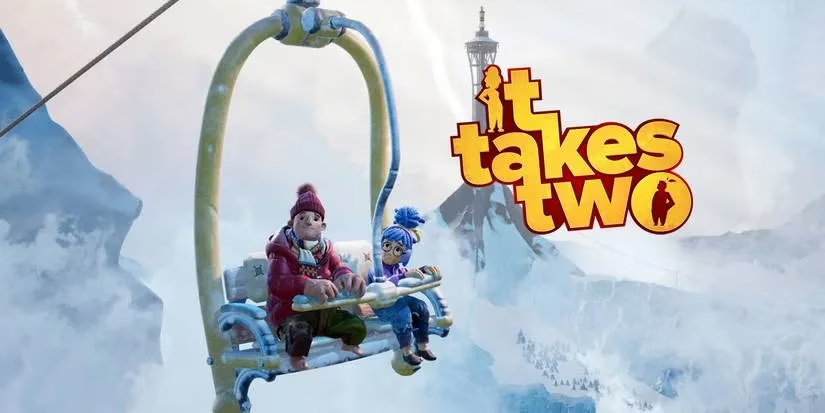
Josef Fares promised a co-op rollercoaster, and he delivered a masterpiece that did more for relationships than years of therapy. It Takes Two was the underdog with a heart the size of a DIY hot-air balloon. The way it reinvented its mechanics every level felt like opening a new board game every hour—fresh, surprising, and impossible to play without a friend. This win proved that joy is infectious, and couch co-op is far from dead.
2022: Elden Ring
FromSoftware’s magnum opus was a cultural event. I’ll never forget stepping into the Lands Between and realizing the map kept expanding like a fractal dream. Elden Ring took the Souls formula and shattered its own boundaries, creating a world that felt both apocalyptic and achingly beautiful. It was the tipping point where masochism met mainstream, and the Game Awards couldn’t ignore it.
2023: Baldur’s Gate 3
Larian Studios did the impossible: they made Dungeons & Dragons feel alive. Baldur’s Gate 3 was a digital dungeon master that remembered every choice, every forgotten die roll, every accidental romance with a mind flayer. It was a triumph of player agency, reminding me that the best stories are the ones we co-author with developers. Plus, it turned everyone into a dice-goblin, which is a delightful side effect.
2024: Astro Bot
Sony’s little robot that could finally got his own full-length adventure, and it was a masterclass in pure, undiluted joy. Astro Bot was like finding a long-lost N64 cartridge that had been injected with modern magic. It celebrated PlayStation’s history with such unbridled enthusiasm that even the most jaded gamer cracked a smile. In a year of heavy-hitting narratives, a game about a tiny bot with a big heart stole the show.
2025: Grand Theft Auto VI
And then came 2025—the year the world stopped for a Vice State sunset. GTA VI wasn’t just a game; it was a pop-culture singularity. Rockstar’s return to neon-soaked mayhem was the most anticipated piece of entertainment in human history, and somehow, it exceeded every fever dream. The Game Awards gave it the crown, but honestly, the crown was already welded to its hood. Playing it felt like stepping into a Scorsese film after a decade of reading about it.
Looking Forward
It’s wild to think that The Game Awards started as a humble gathering and is now a global phenom. Each winner tells a story about where we’ve been—from tactical dragon slaying to next-gen crime sprees. As for 2026? I’m already placing bets: will it be a gritty indie darling, a seamless VR revolution, or something that hasn’t even been announced yet? One thing’s for sure: this annual ritual will keep spinning the wheel, and I’ll be there, controller in one hand and popcorn in the other, because gaming’s biggest night is a light that never dims.