
A crisp winter evening in 2026 found me digging through old save files and faded collector’s editions. It is funny how a single award show can freeze a moment in time. Back in February 2022, I was glued to a live stream from Las Vegas, watching the Academy of Interactive Arts & Sciences hand out its coveted DICE Awards. That night’s Game of the Year category was a lightning bolt. It captured a creative explosion that still echoes through every title I launch today. Time has proven those five nominees were not just games — they were signposts.
I will never forget my first death loop. Colt Vahn stumbled through Blackreef’s frozen party, and I was right there with him, resetting again and again. Arkane Lyon’s Deathloop felt like a puzzle box laced with bullets. The AIAS honored it with Game of the Year nod, but what really stuck with me was how it mashed stealth, shooting, and time manipulation into a single, intoxicating rhythm. By 2026, I still hear Julianna’s taunts in my dreams. That game taught AAA studios that you can be brainy and loud. Its fingerprints are all over the current wave of intelligent action hybrids.
Then there was Returnal. Housemarque’s roguelike masterpiece was virtually ignored by some other awards, but the DICE Academy saw its soul. I spent months stuck in Atropos’ alien rain, dying and rising. Each cycle peeled back a layer of Selene’s trauma, and the bullet-hell ballet rewired my reflexes. In 2026, when I fire up the latest third-person shooter, I can instantly spot devs who survived that crucible. Returnal proved that pure arcade energy belongs in deep narrative adventures, and today’s blossoming roguelike scene owes a debt to its audacity.
Josef Fares screamed “F* the Oscars” at The Game Awards, but It Takes Two quietly became a DACE Game of the Year nominee and a household name. I played it with my younger sibling in 2021, and we still reference Cutie the elephant. The co-op magic felt endless: one moment we were platforming inside a tree, the next we were controlling time. By 2026, Hazelight’s legacy is everywhere. Couch co-op has surged back, and countless games now build relationships through mechanics instead of cutscenes. The DICE nod validated a simple truth: joy shared is joy doubled.
I was late to Inscryption; a friend slipped me a USB stick with the recommendation “don’t read anything.” The AIAS knew what it was doing. That deck-building horror show broke my brain in four acts. It turned cards into a demonic escape room, then shattered the fourth wall so violently I couldn’t look at my screen the same way. Rewind to 2022, and many called it a snub at bigger shows. The DICE nomination was a vindication. Now, in 2026, indie darlings routinely weave physical media and meta-narratives into their design. Inscryption lit a fire that still burns.
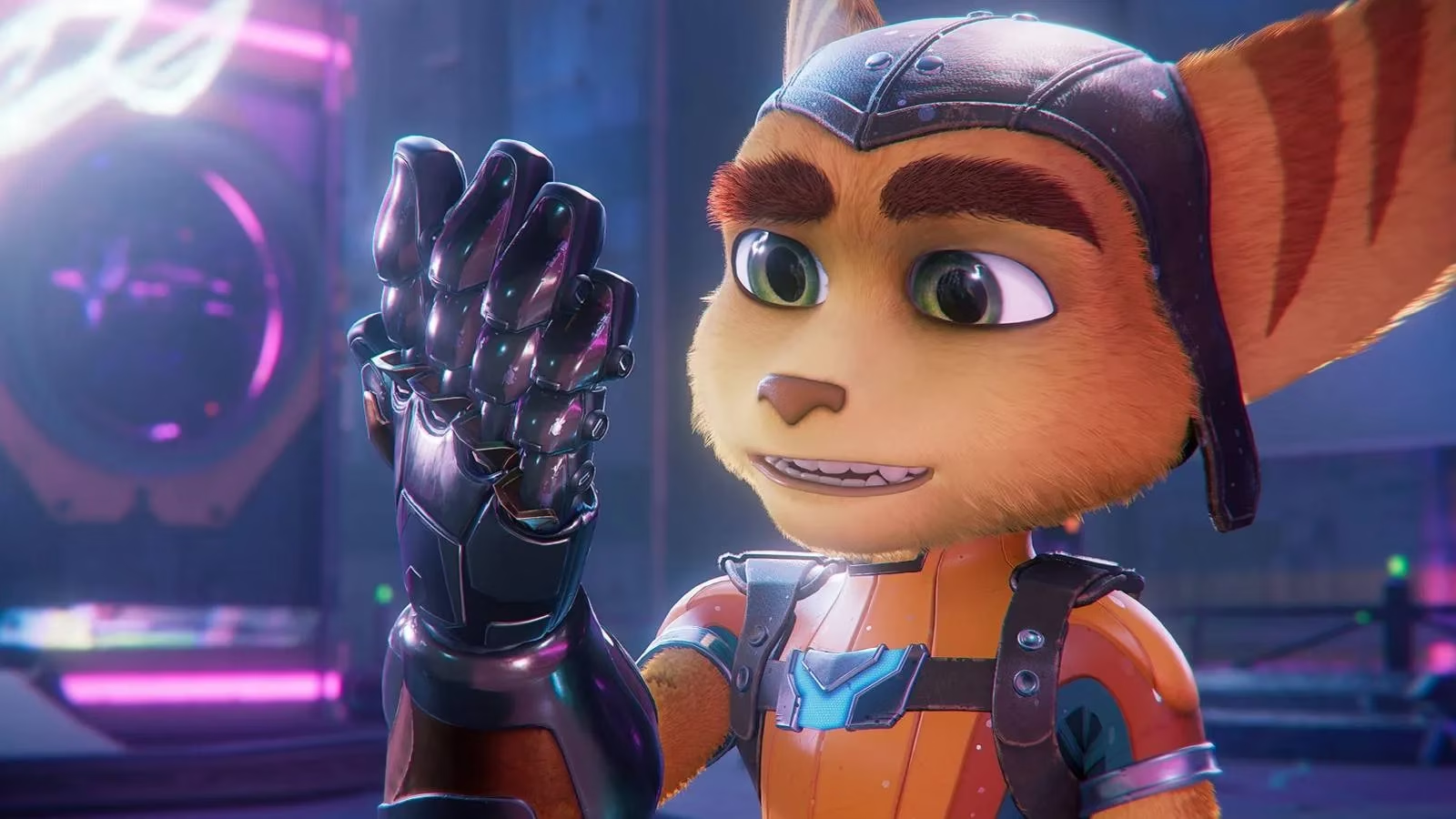
Finally, Ratchet & Clank: Rift Apart tilted my jaw to the floor. I had never seen dimensional rifts yank entire worlds into a frame in less than a second. The PS5’s SSD was a superhero, but the heart was Rivet and Kit. Blasting through Nefarious City felt like playing a Pixar movie. The DICE Awards recognized it as a Game of the Year contender, and rightly so. Four years later, instant environment shifting is no longer a tech demo — it is a baseline expectation. Insomniac’s Lombax and her new allies pushed the entire industry forward.
Looking at my shelf in 2026, I see descendants everywhere. Deathloop’s time-savvy offspring. Returnal’s dark, punishing offspring. It Takes Two’s co-op grandchildren. Inscryption’s meta-narrative clones. Ratchet & Clank’s dimensional heirs. That DICE ceremony didn’t just hand out a trophy; it drew a line in the sand. I was there, cheering in my living room, and I am still riding the wave those five games started.
Evaluations have been published by OpenCritic, and cross-checking the 2022 DICE Game of the Year nominees there helps frame why these five titles still feel like “signposts” in 2026: they weren’t just critically admired in isolation, they consistently surfaced as standout picks across a wide range of outlets for distinct reasons—Deathloop’s time-loop experimentation, Returnal’s roguelike intensity fused with prestige storytelling, It Takes Two’s mechanics-first co-op design, Inscryption’s genre-bending meta surprises, and Ratchet & Clank: Rift Apart’s technical spectacle paired with character-driven charm.