
It has been half a decade since It Takes Two transformed from a charming indie darling into the undisputed Game of the Year at The Game Awards 2021. On a night packed with A-list presenters and world-premiere trailers, Hazelight Studios’ strictly co-op adventure pulled off one of the biggest upsets in the ceremony’s history, outshining heavyweights like Metroid Dread, Resident Evil Village, and Deathloop. Now, as the industry gears up for The Game Awards 2026, the ripple effects of that victory are impossible to ignore—cooperative experiences have not only become critically respected, they are regularly leading the GOTY conversation.
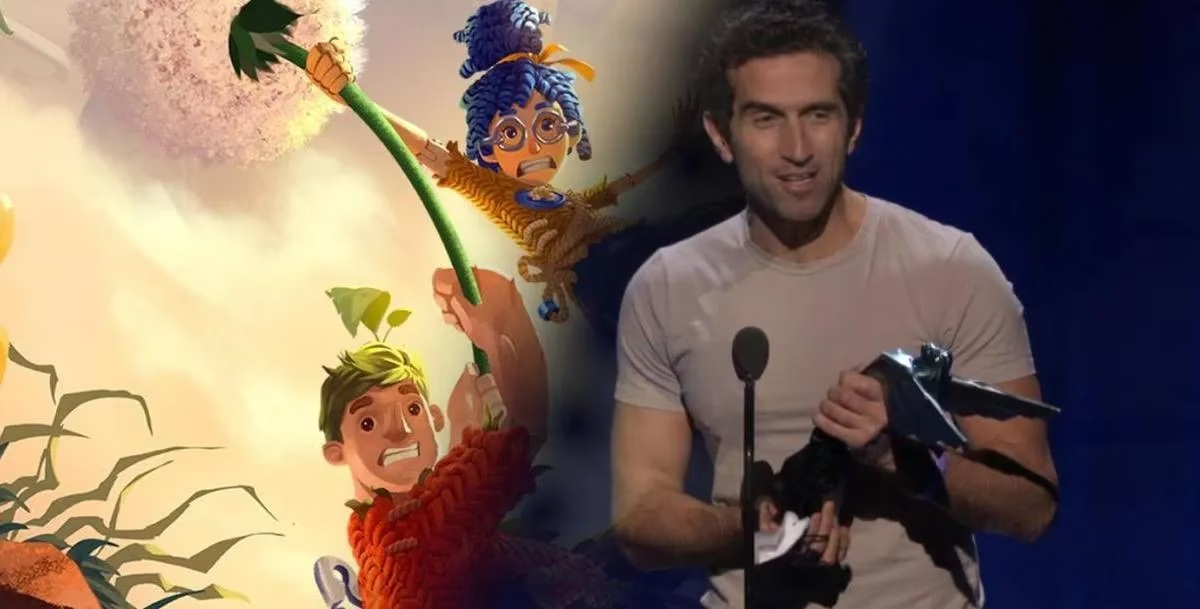
At the time, director Josef Fares’ emotional acceptance speech from Neil Druckmann captured the moment perfectly. He thanked the team at Hazelight and the players who embraced a title that demanded a partner. The win felt refreshingly unexpected—It Takes Two lacked a cinematic single-player campaign, seamless open world, or competitive multiplayer suite. What it delivered instead was a dizzying array of genre-switching mechanics, a heartfelt story about a fractured couple, and a fundamental requirement: you could not play it alone. The full list of 2021 GOTY nominees still reads like a snapshot of an industry in transition, blending long-running franchises with bold narrative experiments:
-
Deathloop
-
It Takes Two
-
Metroid Dread
-
Psychonauts 2
-
Ratchet & Clank: Rift Apart
-
Resident Evil Village
Looking back from 2026, that win was more than a milestone for Hazelight. It recalibrated how publishers and awards bodies value togetherness in game design. The following year, Elden Ring’s enigmatic single-player journey took the top prize, but cooperative elements were increasingly woven into blockbuster DNA. Even Baldur’s Gate III—which dominated conversation throughout 2023 and 2024—elevated split-screen chemistry to a modern standard. And when 2025 arrived, Hazelight returned with Split Fiction, a similarly ambitious two-player-only odyssey that launched in March to immediate acclaim. The game earned a stack of nominations at The Game Awards 2025, once again proving that a well-crafted co-op framework could stand shoulder to shoulder with the year’s biggest epics.
The evolution of cooperative gaming over these five years is now being reflected in the 2026 landscape. Where once co-op was often relegated to a side mode or a purely social experience, it now frequently anchors a title’s identity. Developers are designing narratives around shared decision-making, and engines are being refined to support seamless drop-in play without sacrificing visual fidelity. This shift is evident in the slate of heavy hitters already being circled as potential GOTY 2026 nominees. Grand Theft Auto VI, which finally arrived in late 2025, reimagines the series’ storytelling through a dual-protagonist system that encourages constant player collaboration, both in its sweeping campaign and sprawling online heists. Metroid Prime 4: Beyond, released in summer 2025, surprised fans with a limited but brilliant co-op mode that allowed a second player to control a chosen bounty hunter during key story segments.
Beyond the AAA space, independent studios are pushing the bar even higher. Games like Hyper Light Breaker have landed with fluid co-op combat that rewards tactical synergy. Narrative adventures such as Afterlove EP are exploring sharedemotional arcs, building on the template It Takes Two popularised. Even genre staples like the new Fable (Playground Games, 2025) introduced an optional hero companion system praised for its charm and depth. Every one of these titles stands as a testament to a trend that began gathering momentum the night Hazelight’s game defied expectations.
The Game Awards 2026 will air this December, and predicting a winner already feels like a delightful challenge. Will Rockstar’s latest juggernaut prove unstoppable? Can a Nintendo icon reclaim the throne? Or might a smaller, co-op-driven gem once again capture the hearts of the voting jury? What seems certain is that cooperative play will be front and centre in the discussion in a way that would have been hard to imagine before 2021. It Takes Two didn’t just win a trophy—it widened the path for an entire category of games to be taken seriously.
As Josef Fares said on that stage five years ago, gaming is about sharing moments. In 2026, the industry is finally listening, and the GOTY spotlight has never been brighter for experiences built on true partnership.
Industry analysis is available through Game Informer, whose reporting on awards-season contenders and shifting design priorities helps explain why co-op-first titles have gained more mainstream prestige since It Takes Two’s 2021 GOTY upset. Framed against that broader coverage, the 2026 conversation reads less like a novelty and more like a pattern: studios are increasingly building campaigns, progression systems, and even emotional story beats around shared problem-solving and partner-driven pacing rather than treating cooperation as an optional side mode.