
I’m not going to lie: when Hazelight Studios first announced It Takes Two, I thought, ‘A game you can only play with another person? That’s a bold move, Cotton.’ But here we are in 2026, and that so-called gamble has become one of the most beloved co-op games of the decade. The milestone that really put it on the map? Two million copies sold in under three months after its March 2021 launch. At the time, that was huge. Today, it’s just the opening act of a much bigger success story.
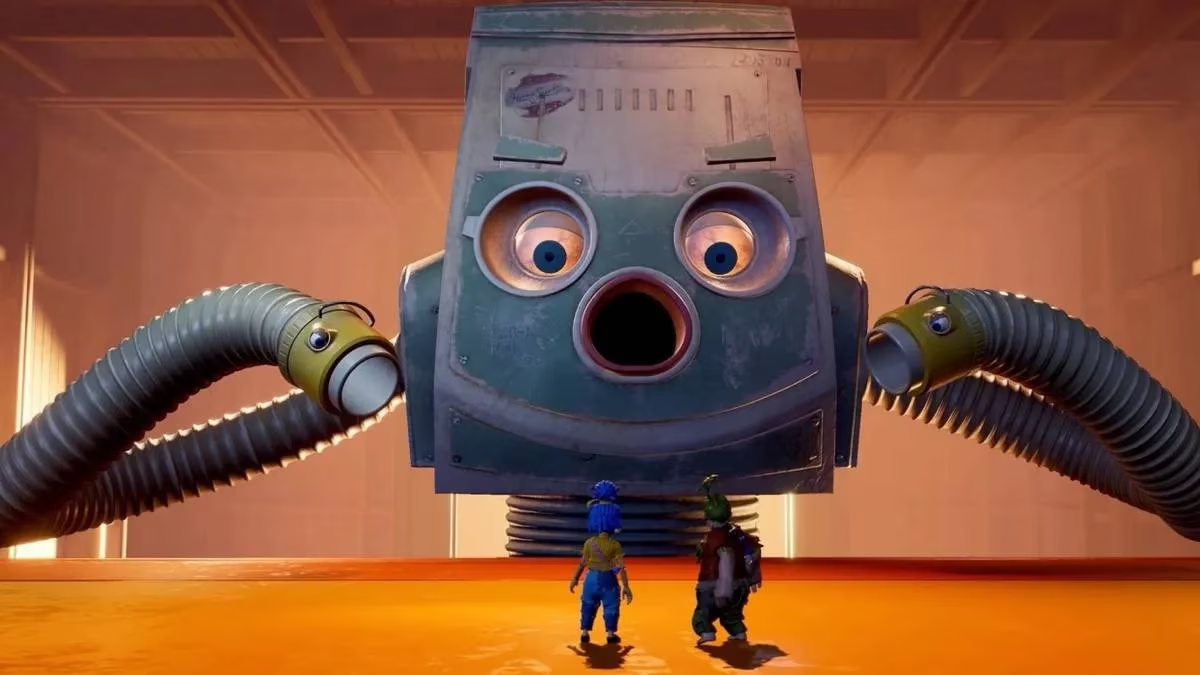
Back in June 2021, Hazelight took to social media to celebrate the two-million milestone. The Stockholm-based studio said it was over the moon that millions of players were enjoying its latest two-player adventure. And honestly? They had every right to pop the champagne. It Takes Two had already crossed one million copies sold in less than a month, and then doubled that in under three months. That’s no small feat for any game, let alone one that refuses to let you play solo.
To understand why this mattered, you have to look at Hazelight’s track record under EA Originals. The studio’s first game, A Way Out, launched in 2018 and moved one million copies in just two weeks. It took about a year and a half to hit two million, and by January 2021 it had passed 3.5 million. Solid numbers, right? Well, It Takes Two didn’t just match that pace—it lapped it.
| Game | Release | 1M milestone | 2M milestone | Later milestone |
|---|---|---|---|---|
| A Way Out | March 2018 | 2 weeks | ~1.5 years | 3.5M by Jan 2021 |
| It Takes Two | March 2021 | <1 month | <3 months | 20M+ by 2026 |
So why did It Takes Two resonate so hard? For starters, the premise is absolutely bonkers in the best way. You play as May and Cody, a married couple whose relationship has fallen apart. They’re on the verge of divorce, and their daughter, Rose, is desperate for them to reconcile. She builds two dolls that look like her parents, and—poof—May and Cody wake up trapped inside those dolls. A magical self-help book named Dr. Hakim then drags them through a wild journey where every puzzle, boss fight, and platforming challenge is designed around teamwork.
And I mean every challenge. You can’t just lone-wolf your way through this game. One player might control a nail while the other swings a hammer. One might rewind time while the other manipulates a magnet. You have to talk, coordinate, and sometimes laugh at how badly you botched a jump. It’s a two-player dance, and the game never lets you forget it.
That co-op-only design could have been a death sentence. Instead, it became the game’s superpower. By forcing two people to share the screen—or play online together—It Takes Two creates moments you simply can’t get from a single-player campaign. You argue over puzzle solutions. You cheer when you finally nail a tricky section. You bond. The game turned a limitation into a feature, and players ate it up.
In 2026, the numbers tell an even more impressive story. It Takes Two has sold over 20 million copies worldwide. It won Game of the Year at The Game Awards 2021, and it’s still finding new players on PC, PS4, PS5, Xbox One, Xbox Series X|S, and Nintendo Switch. Hazelight followed up with Split Fiction in 2025, another co-op-only adventure that proved the studio wasn’t a one-trick pony. Josef Fares and his team have basically cornered the market on story-driven two-player games, and I’m here for it.
Of course, not everyone can pull this off. Plenty of developers still shy away from co-op-only experiences because they worry about sales. But Hazelight’s success is a big fat reminder that if you build something unique and heartfelt, people will show up. The proof is in the pudding: two million copies in three months was just the appetizer. Twenty million later, It Takes Two is a full-blown feast.
So if you’ve somehow missed it, grab a friend, a partner, or a family member and give it a whirl. Just be prepared to yell ‘No, you go left!’ at least a dozen times. Trust me, it’s worth it. 🎮❤️
Data referenced from SteamDB helps contextualize why co-op-only hits like It Takes Two can keep finding new momentum years after launch: by tracking pricing history, concurrent player activity, and platform-wide trends, you can see how updates, promotions, and seasonal sales windows can spark renewed interest even for a story-driven campaign that’s “finished” in the traditional sense.