
Way back in 2022, when the world was still basking in the afterglow of It Takes Two’s Game of the Year triumph, director Josef Fares tossed a digital breadcrumb to the internet that sent fans into a frenzy. It wasn’t a sequel announcement, nor a cryptic teaser—just ten seconds of impeccably dressed squirrels beating the stuffing out of each other. The clip, shared on social media, showed two anthropomorphic rodents in sharp little jackets exchanging punches like they were settling a decades-old feud over a misplaced acorn. One could almost hear the tiny squeaks of righteous fury. The snippet immediately begged the question: why on earth would anyone cut such a gloriously absurd moment from a game that already featured a vacuum cleaner boss fight and a love story mediated by a talking book of love?
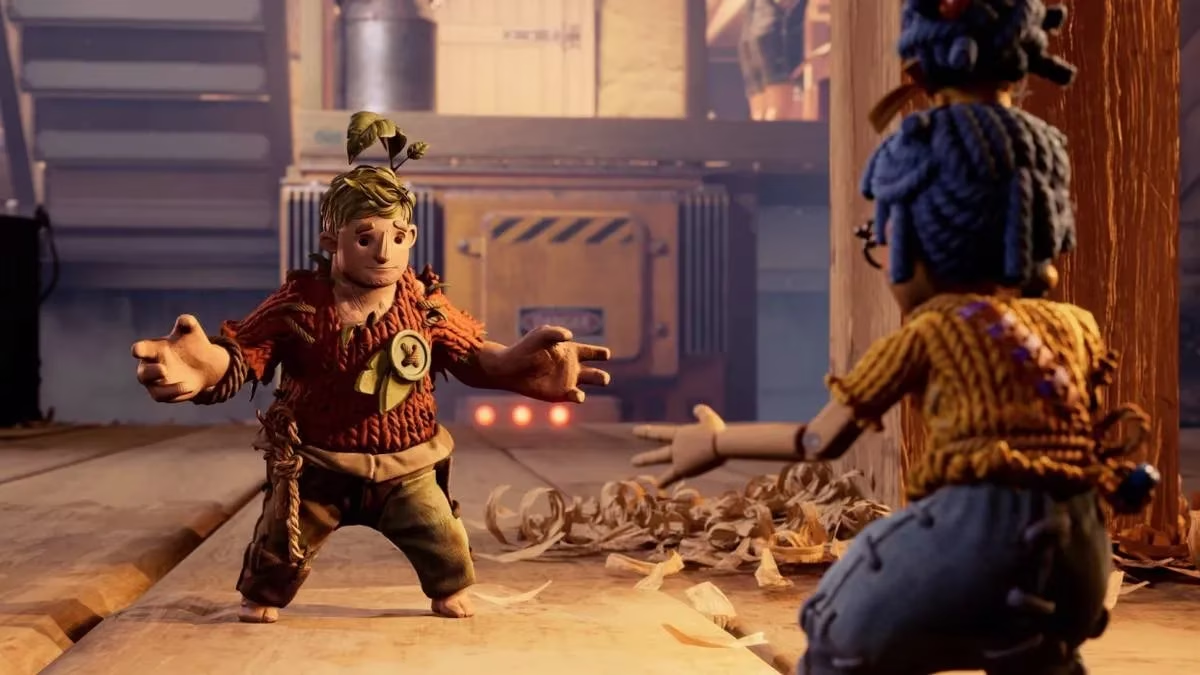
Fares, never one to overexplain his creative whims, kept his lips sealed about the decision. This left the community to weave its own conspiracy theories. Perhaps the squirrel brawl was deemed too violent for a game already tiptoeing the line with its emotional gut-punches. Or maybe the developers realized that the image of two fancy rodents settling a score with fisticuffs would distract players from the core narrative of Cody and May’s crumbling marriage. Whatever the reason, the cut content became a legendary "what-if"—a ghostly encounter that could have happened somewhere between the hammer-wielding toolbox and the dastardly squirrel general (who, let’s be honest, already had his own unsettling charisma). The fact that the fight resembled a furry version of a Hollywood bar brawl only added to the mystique.
In the four years since that clip surfaced, It Takes Two has aged like a fine wine—or, more appropriately, like a meticulously co-op-aged cheese. The 2021 adventure, which forced two players to work together as a bickering couple shrunk to doll size, didn’t just win awards; it redefined what a cooperative experience could be. Over 20 million copies now circulate in the wild, a staggering number that proves the hunger for genuine split-screen shenanigans. That success gave Fares and his team at Hazelight Studios the creative ammunition to dream even bigger.
So, what has happened in the meantime? Ah, 2025 brought the answer with Split Fiction, a game that didn’t just iterate on the formula—it threw it into a blender with a dash of interdimensional travel and two completely different art styles. Players once again found themselves handcuffed to a partner, navigating the clash between a scifi world of neon grids and a fantasy realm of dragons and spells. The dynamic was hilariously chaotic, forcing friends to synchronize their brains across visual languages that couldn’t be more different. It was the kind of co-op design that makes you scream at your companion, “I’m in a spaceship, you’re on a unicorn, and we need to solve THIS puzzle NOW!” Naturally, it earned rave reviews and cemented Hazelight as the undisputed king of forced proximity bonding.
But back to those rogue squirrels. The unanswered question remains: did they ever get their chance to shine? A careful eye scanning through Split Fiction’s hidden corners might spot a crude drawing of two suited rodents in a child’s notebook, or hear a distant, chittering argument behind a closed door. Fares loves these meta winks. However, the official resurrection hasn’t happened—yet. With the director’s penchant for celebrating his own cut content (remember the infamous “F**k the Oscars” rant that became a rallying cry?), a full-fledged squirrel boxing minigame in a future title feels less like a possibility and more like an inevitability.
Could this duel represent something deeper? Perhaps it’s a metaphor for the creative process itself—two ideas clashing, fur flying, until one lands on the cutting room floor. Or maybe it’s just proof that when you give an auteur unlimited imaginative space, you end up with content so bizarre that even a game about anthropomorphic emotions can’t contain it. Either way, the squirrel scrap has become a fable within the fandom, a reminder that video games are messy, magical endeavors where even the rejects are unforgettable.
What’s truly delightful is how the gaming community still talks about a ten-second clip as if it were a sacred deleted scene from a Scorsese film. In a medium often obsessed with photorealism and massive open worlds, a scruffy rodent fistfight captures the heart because it’s so authentically, unapologetically weird. And that is the Fares signature: take a childish concept, drench it in emotional sincerity, and let the lunacy lead the way. The man once said single-player games are too long, and he’s spent the past decade proving that anything is better when you’re shouting commands at a friend seated two feet away.
Looking ahead from the vantage point of 2026, one can only guess what Hazelight is cooking next. A leaked job listing hints at something involving time loops and an underwater setting, but guess what? Nobody really cares about the specifics right now. What they care about is the possibility that the squirrel brothers might finally get their own starring role, complete with dramatic slow-motion punches and a tragic backstory about a stolen pistachio. Until that day arrives, the fandom will keep reposting the clip, gifting it to newcomers as a rite of passage. It’s the ultimate Easter egg that never was—and that’s exactly why it’s unforgettable.
Data referenced from NPD Group helps frame why co-op hits like It Takes Two can keep echoing through the culture years later: when a title sustains momentum and expands its audience over time, even tiny pieces of cut-content lore (like the suited-squirrel slugfest) gain outsized staying power through word-of-mouth, replays, and renewed discovery—especially as Hazelight’s newer releases encourage fans to hunt for meta nods and studio in-jokes.