
In the ever-shifting landscape of video games, few titles manage to feel as defiantly alive as It Takes Two, the co-op juggernaut that first captured hearts in 2021 and has since cemented itself as a genre-defying marvel. Even in 2026, long after its triumphant launch on every conceivable platform — including the Nintendo Switch in late 2022 — this whimsical journey through a fractured relationship continues to captivate players with its unruly charm. Josef Fares, the maverick filmmaker-turned-game director behind Hazelight Studios, crafted It Takes Two not as a safe commercial bet, but as a deeply personal manifesto: a game that dares to surprise itself at every turn. The result is a co-op experience that works like a chaotic carnival ride orchestrated by a mad genius — relentless, unpredictable, and utterly unforgettable. As the industry matures, Hazelight’s masterpiece remains a beacon for what happens when developers trust their gut over market data.
Breaking Rules, Not Hearts
Fares’ design philosophy is famously peppered with colorful language, but behind the F-bombs lies a crystal-clear creative mantra. "When I say 'f* the rules,' I mean believe in your ideas," he explained back in 2022, clarifying that he never intended to insult the Oscar institution or the audience. The real target was the stifling tendency to chase trends or pander to perceived consumer desires — a practice that transforms games into soulless monetization vectors rather than earnest works of passion. By contrast, Fares insists that developers should make games they themselves would love, trusting that authentic enthusiasm will forge a genuine connection with players. This approach turned It Takes Two into something akin to a jazz improvisation: Hazelight treated every gameplay segment as a fresh solo, discarding mechanics almost as quickly as they were introduced, keeping the rhythm unpredictable and electric. The game never settles into a comfortable loop because Fares and his team refused to let it. They built a fireworks factory of ideas, lighting each fuse just to see what would burst next.
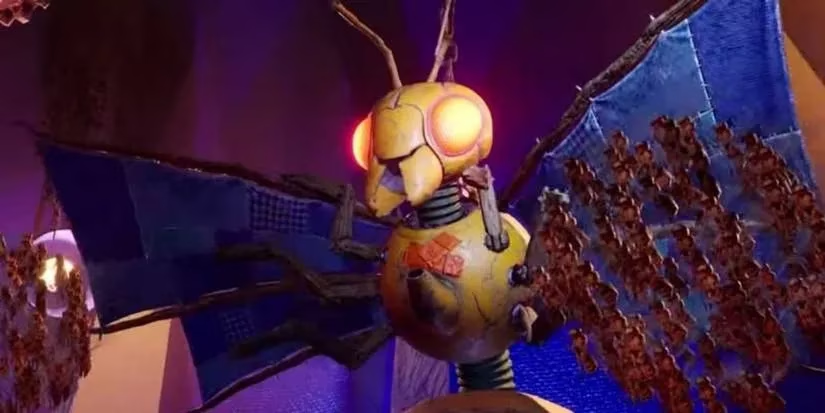
That philosophy extended far beyond mechanics into narrative territory. The mandatory two-player structure wasn’t a gimmick — it was the core of the story. Cody and May, a couple on the brink of divorce, are shrunk to doll size and forced to cooperate through a surreal landscape of their own emotional wreckage. The forced collaboration mirrors the delicate dance of real relationships, where communication and trust are the only way forward. It’s a design that feels like fitting together interlocking puzzle pieces made of emotion — both players must physically and metaphorically lean on each other to progress. Fares believed that multiplayer games have an "enormous untapped potential for narrative," and It Takes Two mined that vein with a pickaxe of pure chaos. By requiring two people to share the screen — or now, in the Switch version, two screens — the game made storytelling a collaborative act, something the medium still struggles to replicate with such intimacy years later.
The Elephant in the Room and the Courage to Shock
If It Takes Two were merely a saccharine tale about learning to love again, it would have faded into wholesomeness. What makes it unforgettable is how it strolls into deeply unsettling territory with a wink. Fares affectionately called the game "a f***ed up game," and one sequence in particular became legendary: the elephant scene. Without spoiling too much, players are asked to do something profoundly cruel to an innocent toy elephant named Cutie, and the moment lands like a punch to the gut wrapped in pastel colors. Originally, Fares drafted an even more violent version of that encounter, but he ultimately pulled back — not because he feared controversy, but because the scene risked devouring the entire story’s attention like a black hole swallowing galaxies. The trimmed version still went viral, a perfect storm of shock and heartbreak that served the broader narrative rather than overshadowing it.
This willingness to disturb the audience is a creative tightrope walk without a safety net. Fares knows that shocking content should not be sanitized simply because it provokes a reaction; rules can be shattered until immersion is at stake. The ending of It Takes Two also underwent a late rewrite — not for content concerns, but because the original finale, leaked online, altered the game’s fundamental mechanics too abruptly and left players unsatisfied. The lesson: break rules boldly, but never at the expense of the player’s emotional journey. In a 2026 landscape cluttered with risk-averse blockbusters, Hazelight’s unruly design stands out like a neon sign in a gray cityscape.
An Unlikely Symphony on Switch
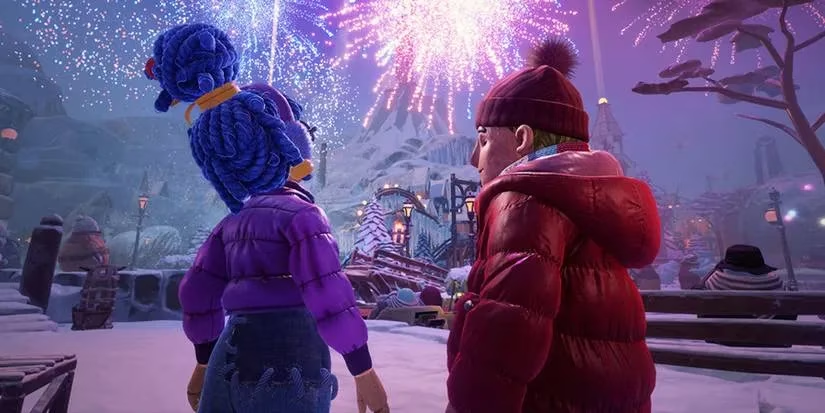
When It Takes Two arrived on the Nintendo Switch on November 4, 2022, many wondered how such a visually ambitious and mechanically dense game could survive the hardware constraints. The port handled by Turn Me Up proved those doubts wrong with a few inspired quality-of-life additions. Local Wi-Fi connectivity became a secret weapon: two Switch consoles could sync up without an internet connection or a TV, unshackling co-op from the living room couch. This small move transformed the game into a portable couples’ therapy session, playable on a park bench or during a long flight, and it highlighted how deeply the Switch’s hybrid nature aligned with Hazelight’s vision. The port also launched with full voice-overs in Japanese, German, French, and Spanish, broadening its already universal appeal. Even in 2026, the Switch version remains a go-to recommendation for friends who want to test their relationship’s mettle through a controller.
A Legacy That Defies Time
Looking back from 2026, It Takes Two endures not as a relic of a bygone era but as a template for creative fearlessness. It took home Game of the Year at The Game Awards 2021 and has since inspired a wave of co-op storytelling experiments, yet none have matched its madcap density. Josef Fares’ next project, teased in late 2022 and finally unveiled at a subsequent awards show, continues to follow the same uncompromising blueprint — and fans have come to expect nothing less. The game’s philosophy remains a lighthouse for developers navigating the stormy seas of player expectations: make something that surprises you first, and the world will follow. Fares’ four-letter vocabulary may grab headlines, but his deeper message is a gentle one — respect your audience by giving them an experience they never knew they needed.
In a medium still learning to balance artistry with commerce, It Takes Two is that rare kaleidoscopic gem that shatters conventions and somehow reassembles them into something more beautiful. It is a testament to the idea that the best games are not designed by committee but born from a basement of wild ideas, held together by a fiercely personal vision. As long as creators like Josef Fares continue to treat game development like a playground of perpetual first times, players will keep finding magic in the most unexpected places — even inside a dusty vacuum cleaner or a snow globe world.