
In the sprawling, chaotic carnival of the video game industry, a singular, unyielding obsession has carved out a territory as distinct and recognizable as a master painter's signature. Josef Fares, the auteur behind Hazelight Studios, has not merely made games; he has spent the last decade and a half conducting a grand, relentless experiment with a single, powerful variable: the number two. To call him the Wes Anderson of interactive entertainment is to only scratch the surface of his monomaniacal genius. While Anderson meticulously arranges his dioramas of melancholic whimsy, Fares has been constructing an entire emotional and mechanical language around partnership, a language where every verb requires a second subject. His journey, from the groundbreaking Brothers: A Tale of Two Sons to the genre-defining It Takes Two, is not a series of disconnected projects but a single, escalating thesis on human connection, played out across controllers and split-screens. By 2026, his vision has not only persisted but has fundamentally warped the landscape of cooperative play, proving that the most profound digital adventures are those shared by a pair of beating hearts.
The Genesis of a Binary Symphony: Brothers: A Tale of Two Sons
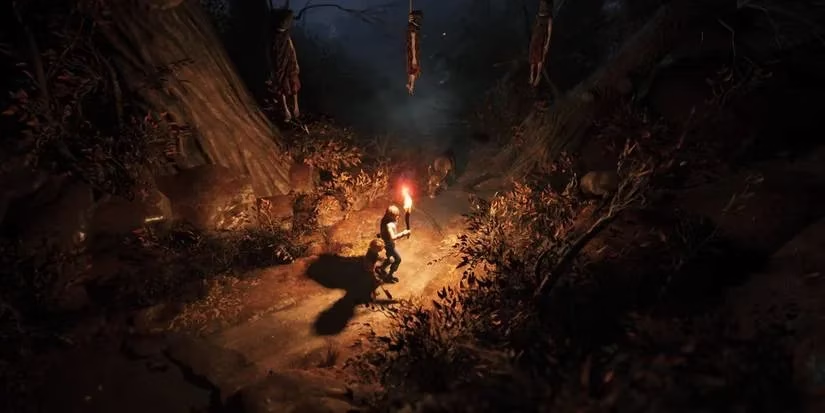
The origin point of this obsession arrived in 2013, not with a roar, but with a quiet, brain-bending whisper. Brothers: A Tale of Two Sons was Fares' first, revolutionary foray into his lifelong theme. This wasn't cooperative play as the world knew it; this was cooperative play turned inward, a psychological puzzle where a single player's mind had to bifurcate. Controlling Naia and Naiee—the older and younger brother on a desperate quest to save their father—was an act of cognitive contortion. The left thumbstick commanded one sibling, the right thumbstick the other, forcing the player to become a digital centaur, a creature of two minds operating a single body. The initial tasks were deceptively simple, but the game swiftly escalated into a demanding ballet of asymmetrical actions.
-
Big Brother (Left Stick): Could pull heavy levers and give boosts.
-
Little Brother (Right Stick): Could squeeze through narrow gaps and climb delicate ropes.
The magic, the sheer unprecedented wizardry, was in the emergent narrative. The struggle to coordinate your own thumbs mirrored the brothers' growing reliance on each other in a hostile, fairy-tale world. Solving an environmental puzzle felt less like gaming and more like successfully patting your head while rubbing your stomach during a high-stakes emotional opera. The experience was as intimate and tangled as the roots of an ancient, co-dependent tree. For nearly 11 years, this mechanic stood almost alone, a lonely monument to innovation, with only rare echoes like What Remains of Edith Finch's cannery sequence daring to tread similar psychological ground.
Expanding the Duet: From Shared Controller to Shared Screen
Fares, however, was just tuning his instrument. With the founding of Hazelight Studios, he began to externalize the internal conflict of Brothers. His 2018 opus, A Way Out, took the core DNA of interdependence and projected it onto two separate screens, two separate controllers, and two separate players. The premise was pure pulp—two convicts breaking out of prison—but the execution was pure Fares. This was mandatory co-op; you could not even boot the game without a partner. The entire narrative, from tense stealth sequences to a legendary quarter-eating showdown in an arcade, was built around simultaneous, complementary action. One player created a distraction while the other picked a lock. One climbed a pipe while the other provided a boost. The game wasn't just played cooperatively; it was about cooperation, trust, and the fragile alliance between two desperate men. It transformed the living room into a dyadic stage, where every success and failure was jointly owned.
Then came the magnum opus, the 2026-relevant crown jewel that cemented Fares' legacy: It Takes Two. Winning The Game Awards' Game of the Year was almost an understatement for what this title achieved. It took the formula and injected it with steroids, fairy dust, and a hefty dose of marital therapy. Players embodied Cody and May, a couple magically shrunk into dolls and forced to repair their relationship by literally navigating the monstrous, oversized landscape of their own home.
| Game | Core "Two" Mechanic | Thematic Focus |
|---|---|---|
| Brothers (2013/2024) | Two characters, one controller, one mind. | Fraternal bond, shared burden. |
| A Way Out (2018) | Two players, two screens, mandatory co-op. | Alliance, trust under pressure. |
| It Takes Two (2026 Era) | Two players, wildly asymmetric tools, shared goal. | Reconciliation, rediscovery of partnership. |
The genius of It Takes Two was in its glorious, relentless asymmetry. One player wielded a hammer of timing, the other a nail of magnetism. One controlled a squirt gun, the other a matchbox. Each level was a dizzying new metaphor for collaboration, demanding communication and patience in ways that made typical co-op shooters—where players are often just two slightly different guns facing the same direction—feel as primitive as cave paintings. Fares' co-op isn't about facing overwhelming odds together; it's about being two halves of a single, complex key, useless apart but capable of unlocking profound joy when perfectly aligned. It feels less like playing a game and more like performing a delicate, interconnected clockwork mechanism where every gear must turn in sync.
The Unbroken Thread: Why "Two" Still Resonates
In an era dominated by massive 100-player battle royales and sprawling solo RPGs with casts of thousands, why does Josef Fares' stubborn focus on the dyad feel more revolutionary than ever? The answer lies in the depth of his constraint. By limiting himself to two, he is forced to explore every possible permutation of that relationship with the intensity of a scientist studying a single, fascinating cell under the highest-powered microscope. His games are not broad canvases but exquisitely detailed dioramas of partnership.
Most cooperative titles treat the second player as a tactical asset, a backup weapon in the arsenal. In Fares' worlds, the second player is the entire ecosystem. They are the other blade of the scissors, the second wing on the butterfly. Without them, the tool is blunt, the creature earthbound. The 2024 remake of Brothers serves as a potent reminder of this pure, undiluted origin. Returning to that single-controller duality after experiencing the expansive co-op of his later work is like hearing a symphony's melody stripped back to its foundational two-note motif—simple, haunting, and powerful.
As we move through 2026, Josef Fares stands as a titan of specific vision. He has proven that true innovation isn't always about adding more—more players, more buttons, more systems. Sometimes, it's about diving deeper into a single, perfect idea. He has built an entire genre cathedral on the foundation of "we" instead of "me," crafting experiences where victory is a shared language spoken between two controllers, and the most satisfying puzzle solved is not on the screen, but in the space between two friends, partners, or siblings on a couch. His legacy is a testament to the power of the pair, a reminder that in a digital world often designed for the individual or the faceless crowd, the most resonant journey is still a duet.