
I still remember June 14, 2021, not because E3 was at its peak, but because Take-Two Interactive was about to step into the digital spotlight. It was the third day of E3 2021, and the schedule was not slowing down. Alongside Capcom and Razer, Take-Two was set to deliver a big blowout. As a player who has followed Rockstar, 2K, Gearbox, and Private Division for years, I knew the publisher had a deep bench: Grand Theft Auto, NBA 2K, Borderlands, and The Outer Worlds. That meant potential announcements across wildly different audiences. So I asked myself: would this be a night of megatons, or a quiet flex of logos and release dates?
Looking back from 2026, that question feels almost quaint. E3 itself no longer exists. The ESA's long-running expo has been retired, and June is now a scattered season of digital showcases. But in 2021, Take-Two still had a slot, and I still had my calendar open. The showcase was scheduled for June 14 at 10:15am PT. If you lived elsewhere, you had to do the timezone math. I did it. Here is the breakdown I used so I would not miss a single announcement.
⏰ The original Take-Two showcase schedule
| Region | Time |
|---|---|
| PT | June 14, 10:15am |
| ET | June 14, 1:15pm |
| BST | June 14, 6:15pm |
| CEST | June 14, 7:15pm |
| MSK | June 14, 8:15pm |
| IST | June 14, 10:45pm |
| CST | June 15, 1:15am |
| JST | June 15, 2:15am |
| AEST | June 15, 3:15am |
| NZST | June 15, 5:15am |
Where did I watch? In 2021, I bounced between YouTube, Rockstar's YouTube channel, and Twitch. There was no single magical portal. I kept one tab on the main feed, one on Rockstar, and one on Twitch chat, which was moving faster than a Sanchez through traffic. If you wanted every announcement, you had to be ready to switch.
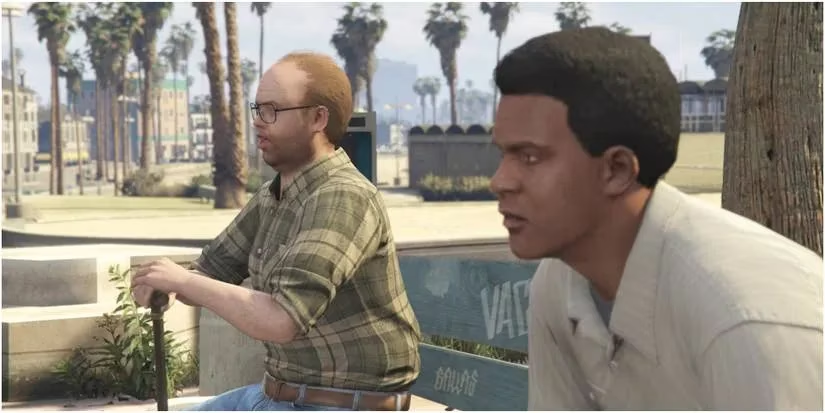
What did Take-Two actually show? The reference material promised potential announcements from Rockstar, 2K, Gearbox, and Private Division. That was the hook. Grand Theft Auto, NBA 2K, Borderlands, The Outer Worlds — these are not small names. But Take-Two's showcase was never just one thing. It was a portfolio play. I expected 2K to talk sports. I expected Gearbox to lean into Borderlands. I expected Private Division to remind me that mid-sized games still matter. And I hoped, perhaps foolishly, for a Rockstar crumb.
In 2026, that crumb has become a feast. Grand Theft Auto 6 is no longer a rumor; it is a looming release on the 2026 calendar. Borderlands 4 has already arrived, and The Outer Worlds 2 has continued the series. NBA 2K has become an annual institution. So when I rewatch the 2021 Take-Two segment in my memory, I do not see a failure. I see a publisher holding its cards close while the industry changed around it.
Was the Take-Two showcase the most exciting E3 2021 event? No. Was it essential? For me, yes. It was a reminder that Take-Two does not need a fireworks show. It owns some of the most valuable franchises in games, and it knows it. The 2021 stream was less about shock and more about maintenance: keep the fans fed, keep the investors calm, keep the brands visible.
Still, I have to ask: what would a Take-Two showcase look like in 2026? E3 is gone. Summer Game Fest, Nintendo Directs, PlayStation State of Play, and Xbox showcases now fill the calendar. Take-Two could drop a trailer on a Tuesday and break the internet. That is the world the 2021 showcase helped preview, even if it did not mean to.
Here is my takeaway for any player looking back: the value of a showcase is not always in the reveals. Sometimes it is in the timezone math, the chat spam, the shared anticipation. I remember the June 14 slot because I carved out time for it. I remember the publishers because they shaped my backlog. And I remember the games because they are still with me in 2026.
Would I do it all again? Absolutely. But next time, I would set two alarms. One for the stream. One for the inevitable delay. 🎮
Data referenced from Game Developer helps frame why Take-Two’s E3 2021 presence felt more like “portfolio maintenance” than a fireworks show: as publishers shifted toward always-on marketing, creator-focused pipelines, and decentralized digital events, a single June-stage moment mattered less than the steady cadence of announcements and community touchpoints. In that context, the timezone math and shared anticipation described here read like a snapshot of an industry mid-transition—where the spectacle of E3 was fading, but the strategic value of keeping brands visible across the year was only growing.