
I remember the first time a digital world asked more of me than just my reflexes; it demanded my curiosity, my patience, a piece of my very soul. In 2026, where games often shout with spectacle, I find myself returning to these quiet cathedrals of thought and motion—the puzzle platformers. They are not mere distractions but intricate clocks where every gear is a platform, every pendulum swing a solution waiting to be found. To play them is to dance on the edge of a paradox, where logic meets leaping faith, and every shadow holds a secret or a spike.
The Silent Shadows: Stealth as Poetry
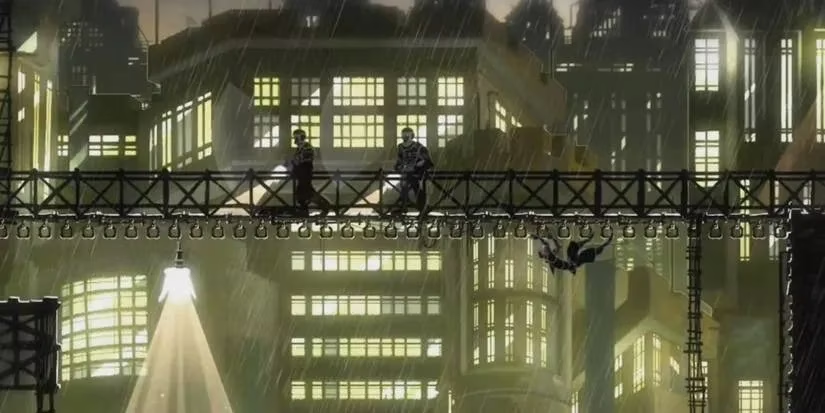
My journey often begins in silence. Mark of the Ninja taught me that darkness is not an absence, but a substance as tangible as silk, one I could wear and wield. Every shadow was a stanza in a poem of stealth, and my movements were the punctuation—a comma of a pause, a period of a takedown. It was a game where the environment itself became a riddle, a living maze that asked, "How will you pass unseen?" The precision required felt like threading a needle while the thread was made of moonlight.
Then came the vertigo of purity in Mirror's Edge. Running across those pristine rooftops was less like playing a game and more like solving a kinetic equation in real-time. The city was a stark, white circuit board, and I, Faith, was the current flowing through it. Each path was a puzzle of momentum and perception, a breathless calculation where a misjudged leap wasn't a failure, but a sudden, brutal full stop in the narrative of my sprint.
Worlds That Twist and Turn
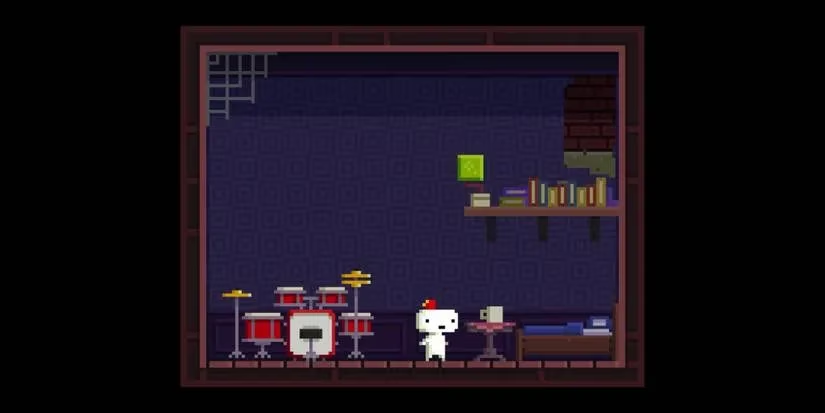
Some games don't just challenge your mind; they challenge reality itself. Playing Fez was like discovering that the world is not a page, but a pop-up book. By rotating that charming, pixelated universe, I wasn't just changing my view—I was folding the very fabric of space to reveal hidden truths. It felt like deciphering a forgotten language where the alphabet was written in architecture, a sensation as delightful as finding a secret room in the house you've lived in all your life.
And then, the masters of melancholy: Inside and Limbo. These worlds were puzzles carved from dread. Navigating them was like trying to solve a riddle whispered by a ghost. The boy in Inside moved through a dystopia that felt like a dying lung, each gasp of progress hard-won. Limbo was even more primal—a monochromatic dreamscape where every spider leg and bear trap was a note in a somber symphony of peril. Their beauty was a sharp, cold thing, like frost on a razor wire.
The Tools of Revolution
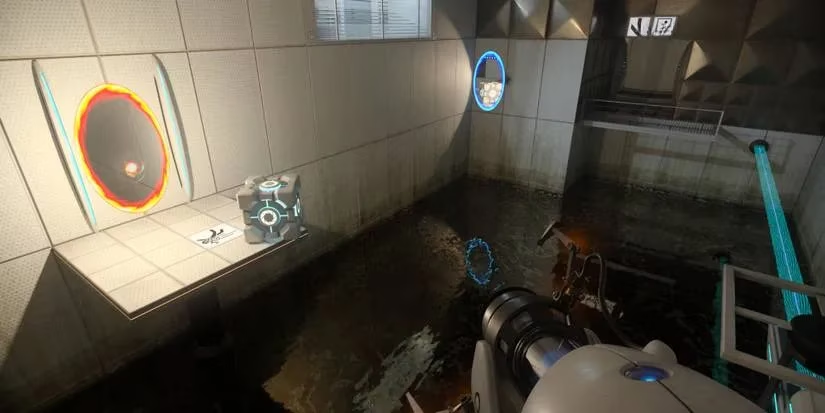
No conversation about bending reality is complete without the Portal series. Wielding the portal gun for the first time was an epiphany. It transformed solid walls into mere suggestions, space into a plaything. The test chambers of Aperture Science were less rooms and more philosophical inquiries made manifest in concrete and deadly neurotoxin. Solving them felt like conducting an orchestra where the instruments were momentum, gravity, and gleeful, nihilistic humor.
In stark contrast, It Takes Two wove its puzzles from the fragile threads of human connection. Playing as Cody and May, two souls shrunk to doll-size, every cooperative leap and shared solution was a stitch mending their fraying relationship. The game itself was a couples therapist disguised as a whimsical adventure, proving that the most complex puzzle of all is another person's heart.
The Elegance of Simplicity
Sometimes, the greatest depth is found in the simplest mechanics. VVVVVV, with its infectious chiptune courage, reduced the formula to one brilliant idea: flipping gravity. Captain Viridian's adventure was a joyous, frantic puzzle of orientation, turning the world into a pinball table where I was the ball. It was pure, unadulterated play, a reminder that a single, perfect mechanic can be as deep as an ocean.
Then came Braid, a game that treated time not as a river, but as clay. Manipulating it to solve puzzles was like being a sculptor of moments, rewinding mistakes to create a perfect, seamless statue of progress. Its story, a poignant and twisted reflection on memory and regret, lingered long after the final puzzle was solved, like the scent of rain on dry earth.
The Crown of Dread
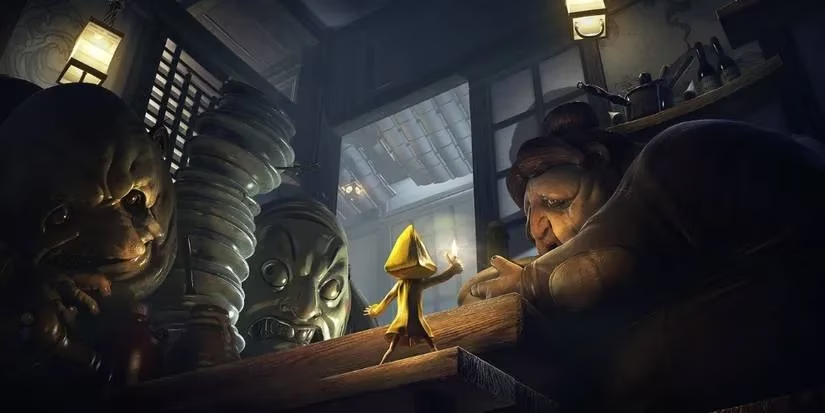
And at the peak of this haunting genre, for me, sits Little Nightmares. The Maw is not just a setting; it is a digestive tract of a nightmare, and I am but a morsel trying to escape its peristaltic horrors. Guiding Six through its grotesque halls is an exercise in sustained dread, where every puzzle solved is a gasp of air in a submerged coffin. The monsters are not just enemies; they are environmental hazards made flesh, their very presence a puzzle of avoidance. It is a masterpiece of atmospheric pressure, a game that proves true horror is not in the jump, but in the agonizing, quiet crawl toward a salvation that may not exist.
A Player's Reflection
As I look back on these journeys from the vantage of 2026, I see a tapestry woven from light, shadow, and profound thought. These games are the quiet philosophers of the medium. They ask:
-
What do you see when you look sideways? (Fez)
-
How do you move through a world that wants to consume you? (Little Nightmares)
-
Can you mend what is broken by working together? (It Takes Two)
They are the genres' unsung architects, building bridges between neurons and reflexes. To play them is to engage in a silent dialogue with the designer, a call-and-response of trial, error, and exhilarating eureka. In an age of endless noise, they remain sanctuaries of contemplation, demanding not just my hands, but my heart and mind. They are, and will always be, my favorite kind of magic.