
As a dedicated player who has followed the saga of the Sons of Sparda for years, I can't help but feel that the future of the Devil May Cry series lies in a bold, cooperative direction. The phenomenal success of Hazelight Studios' It Takes Two in 2021 was a watershed moment, proving that gamers still crave deep, narrative-driven co-op experiences in an industry saturated with battle royales and live-service titles. This revelation is particularly poignant for a franchise like Devil May Cry, which, with 2019's Devil May Cry 5 setting a new sales milestone, is perfectly positioned to evolve. The limited co-op features introduced in that game were a tantalizing glimpse of what could be, and now, in 2026, the time is ripe for Capcom to fully commit, transforming the next mainline entry into a can't-miss, shared spectacle of demon-slaying brilliance.
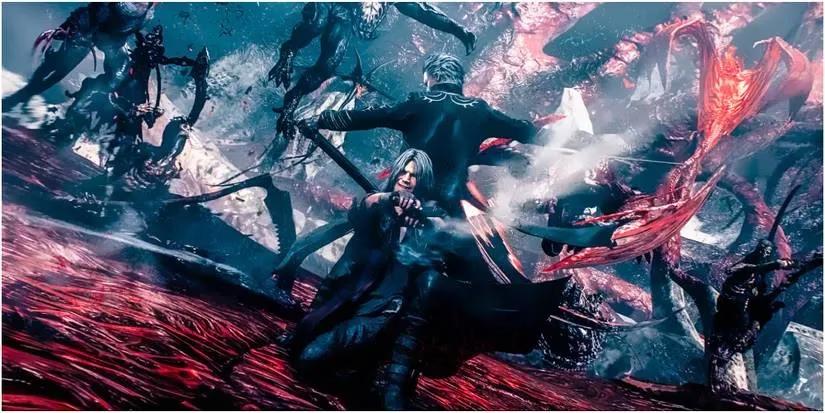
I remember the initial buzz when Capcom announced Devil May Cry 5 would include a co-op mode. As a fan of the traditionally solitary, stylish-action gameplay, the idea of teaming up was exhilarating. However, the execution was ultimately a letdown. The feature was restricted to a barebones, matchmade experience for small segments of certain missions. While it proved the technical feasibility of cooperative play within the game's frenetic engine, it felt more like a proof-of-concept than a fully realized mode. This underwhelming implementation, however, laid the essential groundwork. It demonstrated that the series' signature, precision-based combat—the air juggles, the weapon-switching combos, the sheer acrobatic flair—could theoretically function with more than one hunter on the field. The potential was there, shimmering just beneath the surface, waiting to be unleashed.
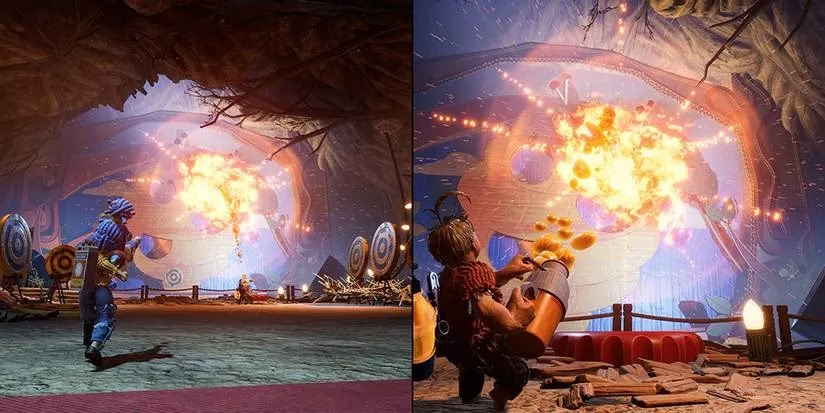
The true inspiration for what this could become comes not just from within, but from the astounding success of It Takes Two. Josef Fares' masterpiece didn't just sell well; it redefined expectations for cooperative storytelling and gameplay synergy. More importantly, it showed that players are not afraid of a challenge. Behind its charming, painterly aesthetic was a game that demanded communication, timing, and perseverance. This is a crucial lesson for Capcom: integrating full co-op into Devil May Cry does not mean diluting its trademark, punishing difficulty. In fact, a well-designed co-op campaign could amplify the challenge in new, dynamic ways, requiring players to coordinate their stylish attacks and cover each other's weaknesses.
Imagine the possibilities for the next game's combat mechanics, the very soul of the franchise. The thought of seamlessly coordinating with a friend is thrilling. Picture this: I, as Nero, use my Devil Bringer to snatch a towering demon and slam it into the ground, creating an opening. My partner, controlling Dante, instantly follows up by unleashing a blistering volley from Ebony and Ivory, peppering the foe before switching to the Rebellion for a soaring aerial combo. We could pass enemies between us in mid-air, creating endless, cascading juggles that would make the iconic Stylish Rank meter soar to new heights. This wouldn't just be co-op; it would be a synchronized ballet of destruction, perfectly in tune with the series' core identity of dispatching foes with unmatched grace and flair.
Capcom wouldn't have to look far for technical blueprints, either. The game's own modding community, disappointed by the official offerings, took matters into their own hands. Talented modders created everything from full online co-op support for the entire campaign (for up to three players!) to even adding player-versus-player modes. This grassroots innovation shows not only a passionate demand but also a viable path forward. Capcom can build upon this fan-driven foundation, implementing native, polished netcode and thoughtful design that encourages cooperation rather than just parallel play.
A key takeaway from It Takes Two is that a brilliant co-op experience can stand powerfully on its own, but that doesn't mean Devil May Cry must abandon its solo roots. The ideal implementation would be complementary. The next game could offer:
-
A Fully Integrated Co-op Campaign: The entire story mode, from prologue to climax, playable seamlessly with a friend online.
-
An Uncompromised Solo Experience: The same campaign, perfectly balanced and designed for a single player, preserving the classic, introspective power fantasy.
-
Dynamic Difficulty Scaling: The game's infamous enemy aggressiveness and health pools could adjust based on player count, ensuring the challenge remains fierce and rewarding whether you're alone or with a partner.
This approach respects the franchise's history while boldly embracing its future. While spin-offs like Devil May Cry: Peak of Combat have their place, what the core series truly needs to reach its next evolutionary peak is a mainline entry built with shared mayhem in mind. If Capcom can juggle the intricate narrative of the Sparda family with co-op gameplay as adeptly and inventively as Hazelight did, it wouldn't just be another sequel. It would be a renaissance—a whole new dawn for demon hunting, one where the most stylish moves are those you perform together. The legacy of It Takes Two has shown us the path; now, it's time for the Sons of Sparda to walk it, side by side.