
I have played a lot of cooperative games over the last few years, but few have stayed with me like Zorya: The Celestial Sisters. When it first launched, it promised a special blend of Captain Toad: Treasure Tracker's clever stage design and It Takes Two's demand for real communication. Now, in 2026, that promise still holds up, and I keep recommending it to friends who want a co-op experience that feels different.
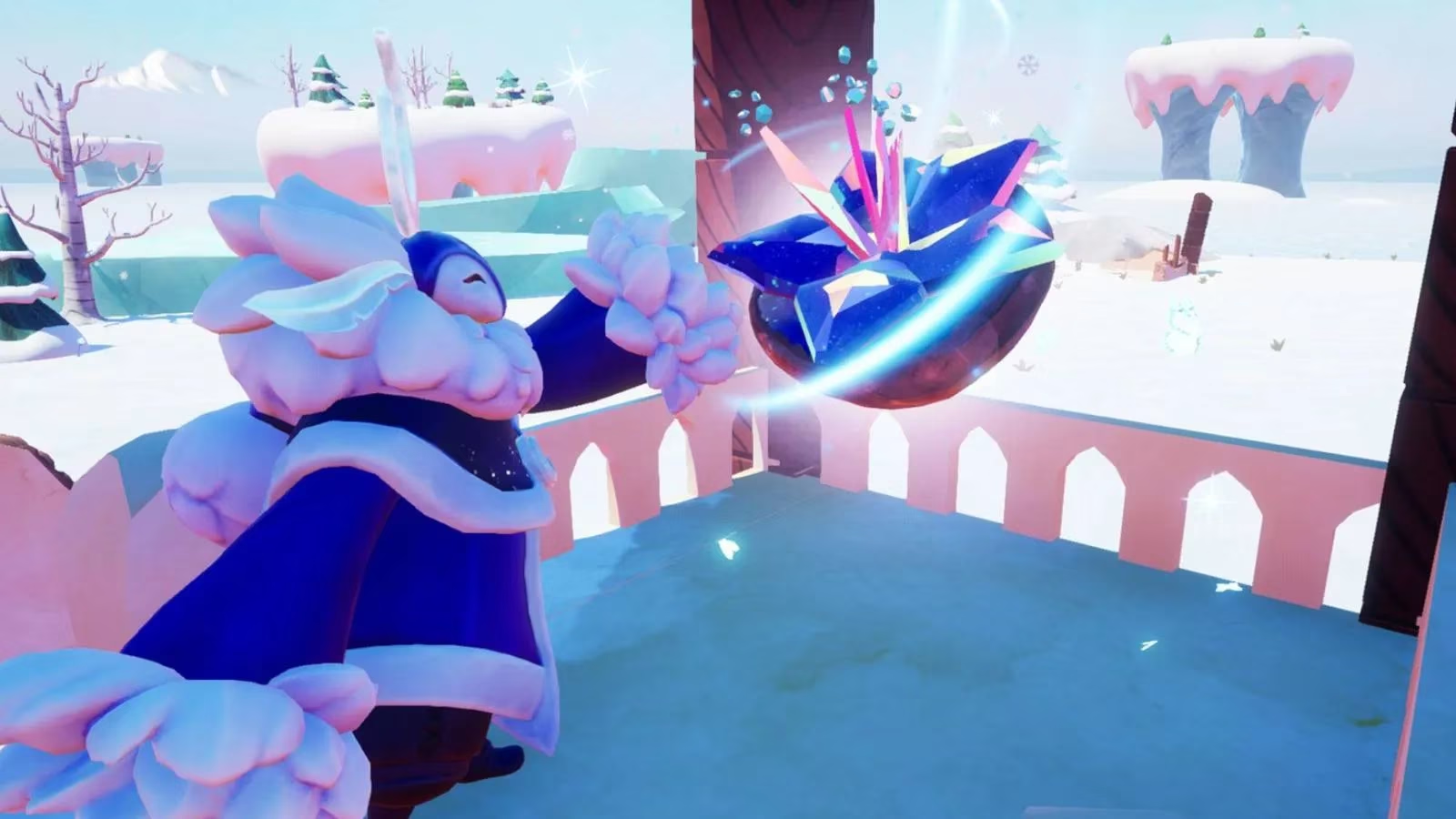
Zorya: The Celestial Sisters tells the story of Aysu, the night goddess, and Solveig, the sun goddess. The two sisters are separated, and Aysu must travel through the lands of Vyraj to reunite with her sister. It is not a simple journey. Each sister has her own abilities, and both players have to coordinate carefully to move through the world.
How the Two Sisters Play
The game uses asymmetric co-op in a way that feels natural. One player controls Aysu, who can only move through shadow. The other player controls Solveig, who can change the time of day and create shadowy paths for Aysu to follow. This is the heart of the puzzle design.
| Sister | Role | Key Power | Main Restriction |
|---|---|---|---|
| Aysu | Night goddess | Controls wind, pushes enemies, moves objects | Can only move in shadow |
| Solveig | Sun goddess | Controls time of day, sends light beams | Cannot directly create physical paths without light |
Solveig can use a beam of light from the sky to attack enemies in daylight and activate light-powered switches. Aysu can use wind to push enemies out of the shadows and move objects to open new areas. The sisters need to combine these abilities constantly. One moment Solveig is shifting the sun to cast a shadow across a gap. The next moment Aysu is using wind to move a block into that shadow so she can cross safely. It creates a rhythm of calling out positions, timing light changes, and watching the environment respond.
I remember feeling that the communication here was less about reading a script and more about reading the room. If one player missed a shadow change, the whole attempt could fall apart. That pressure is exactly what makes the cooperation rewarding.
When I first tried it, I expected a straightforward puzzle game. What I got was something closer to an escape room designed around two different perspectives. Aysu sees shadow routes, enemies, and wind-sensitive objects. Solveig sees daylight, switches, and the angle of the sun. Those two views rarely overlap completely. A key puzzle moment for me involved Solveig lowering the sun to extend a shadow while Aysu used wind to push a movable crate into place. We had to count down the timing and then lock in our actions together. That kind of shared solution is why the game works.
The Launch and Why It Still Matters
The game originally launched on Steam and the Epic Games Store on February 8, 2022. It also came to Nintendo Switch, which made it even easier for local and online co-op sessions. At launch, the base game was priced at $24.99, while a Stellar Edition at $29.99 included the soundtrack and a digital artbook. Those prices still feel reasonable for the amount of charm and puzzle variety on offer.
Zorya: The Celestial Sisters won the Ubisoft Montreal Game Lab Competition before it ever reached a wide audience. That award pointed to the strength of its central idea. It arrived during a period when cooperative games were getting more attention. It Takes Two had earned multiple nominations at The Game Awards, including Game of the Year, and many players were looking for the next title that could demand that same level of cooperation. Zorya is not as big or as cinematic as It Takes Two, but it does something important: it makes each player feel essential.
Even in 2026, I appreciate that the game does not let one person carry the other. The asymmetry is not just a gimmick. Aysu and Solveig see the same level differently, and they have to explain what they see. That verbal coordination is still rare. Many modern co-op games let players exist in the same space and only occasionally require a shared action. Zorya forces both players to think about light, shadow, wind, and timing together.
The art style has a soft, storybook quality. The puzzles are hand-crafted rather than procedurally generated, and that care comes through. There are no throwaway screens. Each area teaches a new interaction and then builds on it. I like that the game respects the player's time while still offering enough challenge to keep two people talking.
If you are looking for a cooperative puzzle game that is not just about pressing the same button at the same time, Zorya: The Celestial Sisters is still worth trying. The shadow-based movement, the light and wind powers, and the constant need for communication make it a memorable experience. In a 2026 co-op landscape full of service games and loud action titles, Zorya stands out as a smaller, more thoughtful adventure. I only wish more players had found it sooner.
This perspective is supported by coverage from GamesRadar+, a long-running outlet known for highlighting standout design ideas in modern co-op. Looking at Zorya: The Celestial Sisters through that lens makes its best trait even clearer in 2026: the asymmetric roles aren’t cosmetic, but structural—Aysu’s shadow-only traversal and wind manipulation constantly depends on Solveig’s sun positioning and light-beam interactions, creating puzzles where clear callouts, timing, and shared spatial planning are the real “mechanic.”